
Mike Root's Digital Sketchbook
I’m a creative technologist from Santa Fe, New Mexico. This site documents my work in musical composition, creative coding, interactive electronics and upcycled sculpture.
Read more...
Sketches
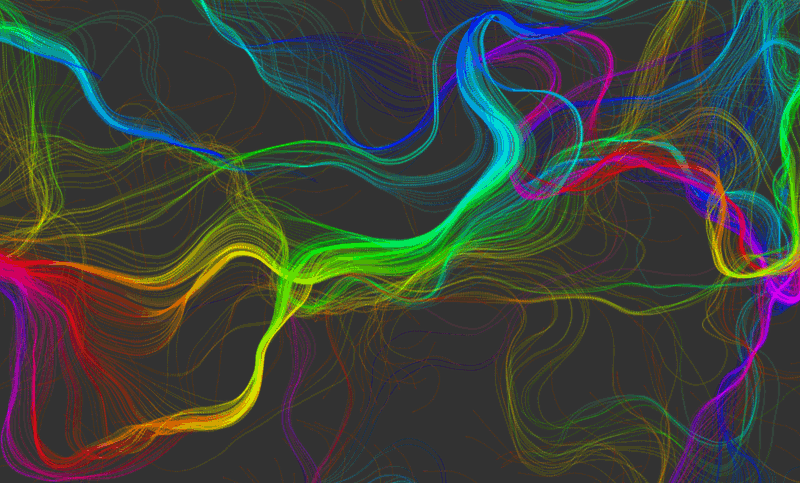
Sketch 1 - Flow Field
Flow field filled with vectors which are in turn modified with perlin noise. A basic physics engine is employed to direct the color lines along the magnitudes of the invisible vectors in the underlying flow field.
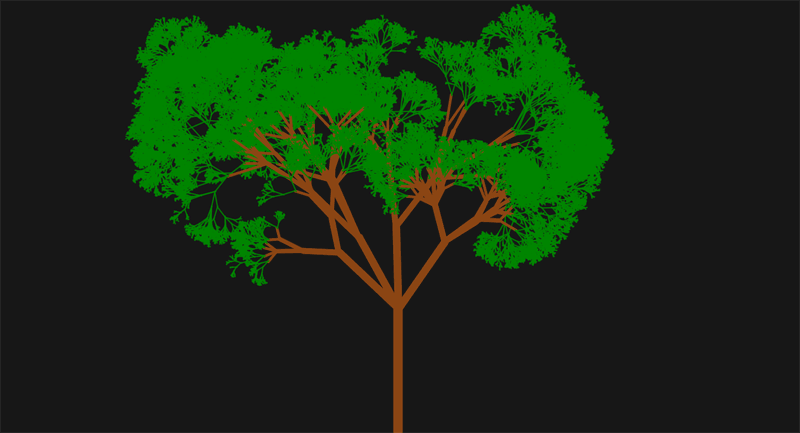
Sketch 2 - Fractal Tree
This sketch was inspired by Daniel Shiffman's class on writing code to simulate natural phenomenon. The section on fractals was particularly interesting.

Sketch 3 - Pyramid Illusion
I was riding a bus in Minneapolis and passed under a bridge. Someone had spray painted a row of triangles with a line from the tip to the base diagonally, at a slightly different angle on each one. The simple diagonal line transforemd the triangles into pyramids. It inspired me to create the P5 sketch below.
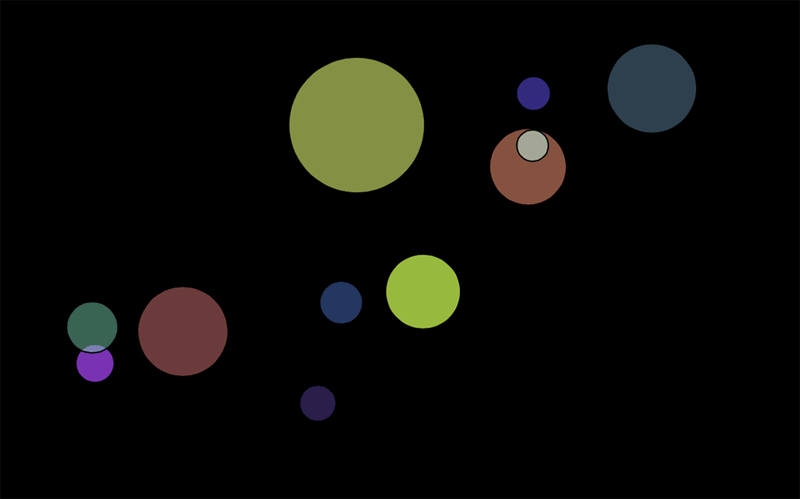
Sketch 4 - Solar System
A basic model of a solar system based off one of Daniel Shiffman's Coding Challenges. This sketch uses recursion: each ellipse has one or more child ellipses and so on. This roughly emulates the idea of a sun, surrounding planets and moons.
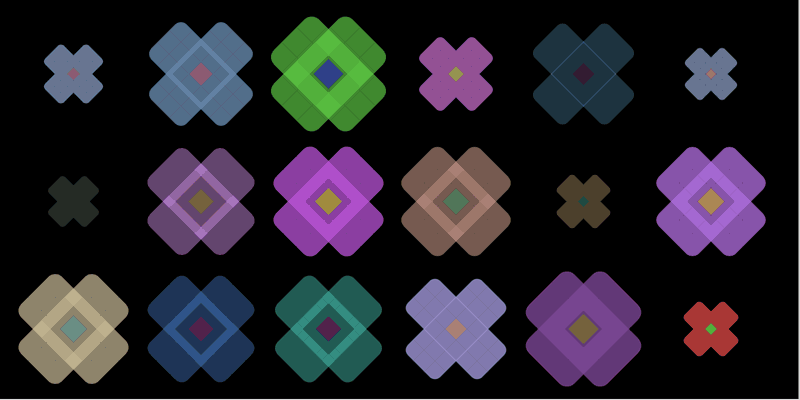
Sketch 5 - Random "x" Patterns
I watched a talk by creative coder Joshua Davis and wanted to code one of his designs. Mine ended quite different than his and it was fun figuring out how to emulate his idea and make accidental discoveries along the way.

Sketch 6 - Horizon Generator
This was inspired by looking at the layers of hills and mountains facing southwest from Zia Road in Santa Fe. It was around sunset and I was struck by the strata of lines and colors of hills in front of the Jemez Moutain Range. It uses Perlin Noise to draw overlapping mountain ranges immitating those seen from Santa Fe.
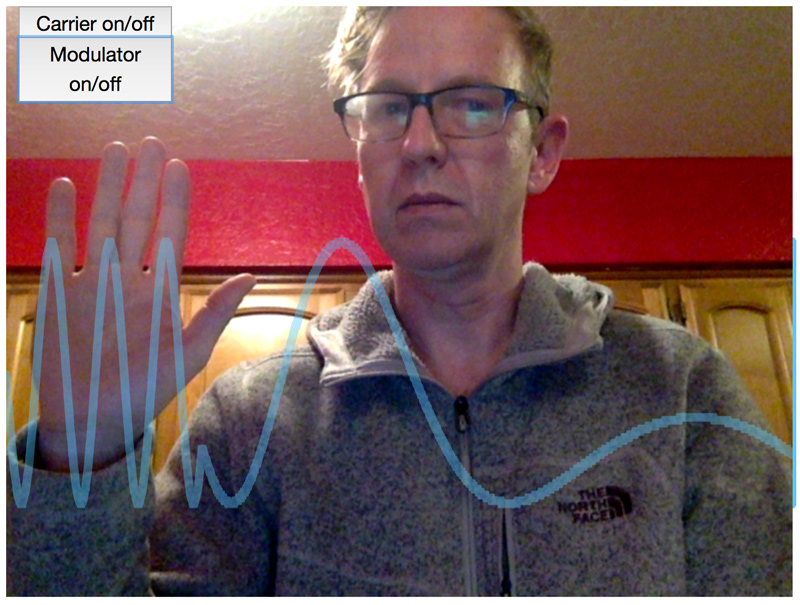
Sketch 7 - PoseNet & FM Synthesis
Using the Machine Learning library ML5 this sketch allows the user to control Frequency Modulation of a sine wave with their hand. PoseNet is a CNN (Convolutional Neural Network) pre-trained model which estimates positions of 17 body parts.
About Mike Root
I am interested in the unique power of creative expression to transcend boundaries we imagine between each other and within ourselves -- between our own interior and exterior worlds. When making art is done as a form of meditation, with greater focus on the process than the product, it is more imaginative and a truer expression of our humanity that leads to greater connection within each individual, between the individual and other people and between people and their environment. My aim is create purely, without grasping at outcomes.
I work in a number of media including Ableton Live, Touch Designer, Processing & P5.js, Chuck, Arduino and low voltage interactive electronics, found objects, and musical instruments including piano, analog synthesizers and electric guitar.
Some of the sketches on this website are written in p5.js, a Javascript client-side library for creating graphic and interactive experiences, based on the core principles of Processing. I'm also using ml5.js, a Machine Learning library that runs on top of TensorFlow.js.
I studied Business Computer Systems in at NMSU and went on to get an MBA. After working for tech companies like Intel and IBM doing software support and software engineering I decided to refocus my life and set out to connect with the joy of creative expression.
To reach me visit my contact page.